
Thermal management is undoubtedly a crucial factor in today’s semiconductor, power module, and photonics systems industries. Whether using silicon, silicon carbide, or gallium nitride, the pursuit is for higher operational efficiency, switching speeds, and integration density. However, a common question remains: are current metal heat dissipation solutions still sufficient? After all, engineering ceramics, once considered rare materials, are now increasingly indispensable. Below, we examine the true differences between thermally conductive metals and engineering ceramics in terms of thermal performance, electrical performance, and long-term reliability.
Thermal Behavior: Conductivity vs. Thermal Path Efficiency
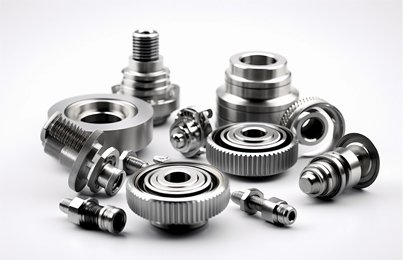
Metals: Great Conductors, Imperfect Systems
Copper and aluminum are incredibly efficient heat conductors on paper.
But in semiconductor applications, thermal conductivity alone does not solve the real problem.
Why?
Because metal’s electrical conductivity forces engineers to introduce dielectric layers—coatings, films, thermal pads—each adding thermal resistance. The result is a thermal path that is less efficient than the raw conductivity numbers suggest.
Metals conduct heat extremely well,
but the system around them does not.
Ceramics: Slightly Lower Conductivity, Better Real-World Cooling
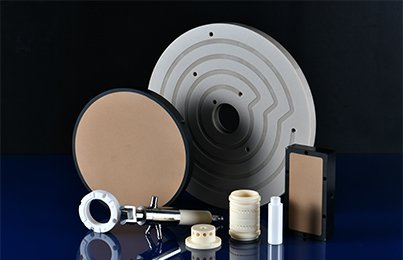
Technical ceramics such as aluminum nitride (170–230 W/m·K) or silicon carbide (120–200 W/m·K) may not match pure copper, but the overall thermal path tells another story:
They require no electrical insulation layer
They can be placed directly under the die
Their surfaces bond strongly with solder and metallization
Their thermal expansion matches Si, SiC, and GaN
In real thermal stack-ups, ceramics often perform better than metals because they eliminate extra interfaces.
In other words:
Metals move heat well. Ceramics move heat smarter.
Electrical Performance: Intrinsic Insulator vs. Necessary Liability
Metals: Conductive by Nature
In power electronics and high-voltage systems, metal’s conductivity is a double-edged sword.
Every metal plate, heat sink, or spreader requires:
Dielectric coatings
Insulation pads
Potting materials
Dielectric oils or greases
Each layer adds failure modes—breakdown, delamination, thermal aging.
This becomes especially problematic in:
High-voltage SiC modules
RF and microwave amplifiers
Automotive inverters
Laser packages and photonics
Ceramics: Thermal Conductors That Don’t Carry Current
Technical ceramics are uniquely positioned:
They dissipate heat while blocking current.
This simple combination unlocks powerful design advantages:
Integrated insulation (no extra layers)
Simpler stack-up
Lower parasitic capacitance
Higher breakdown strength
Better high-frequency performance
For RF engineers, device designers, and high-voltage module architects, ceramics turn into a material that not only cools but also stabilizes the electrical environment.
Reliability: The Often Ignored but Most Critical Difference
Metals: The Problem of Mismatch
Semiconductor materials like Si, SiC, and GaN have small thermal expansion coefficients.
Metals… don’t.
| Material | CTE (ppm/°C) |
| Silicon | ~2.6 |
| SiC | ~4.2 |
| AlN | ~4.5 |
| Copper | ~17 |
| Aluminum | ~23 |
Every thermal cycle stresses solder joints, ceramics, leads, and the silicon itself.
Over thousands of cycles, metals introduce:
Die cracking
Solder fatigue
Warpage
Delamination
Bond-wire lift-off
This is the leading cause of long-term module failure.
Ceramics: Designed for Compatibility and Stability
Ceramics “breathe” at nearly the same rate as semiconductor materials.
AlN matches silicon remarkably well.
SiC matches SiC devices exactly.
High-purity alumina works reliably for mid-power designs.
This compatibility turns ceramics into a structural advantage:
Lower mechanical stress
Greater reliability under power cycling
Better survivability at 150–300°C
No oxidation or corrosion
Zero softening or creep
Reliability engineers know this truth well:
The package usually fails before the device—and ceramics push that failure point much further out.
Final Perspective: Metals Cool Devices; Ceramics Preserve Them
Thermal metals will always have a place in system-level cooling—heat sinks, enclosures, and liquid-cooled plates.
But inside the semiconductor module, where thermal, electrical, and mechanical demands intersect, technical ceramics deliver a balanced, reliable, and future-ready solution.
Metals are thermal tools.
Ceramics are engineered thermal platforms.
And as device architectures continue to evolve, ceramics aren’t just an upgrade—they are becoming the standard foundation for the next generation of semiconductor performance.
 English
  简体中文
简体中文  Español
  Deutsch (Sie)
  日本語
日本語