
Macor-Machinable Glass Ceramic
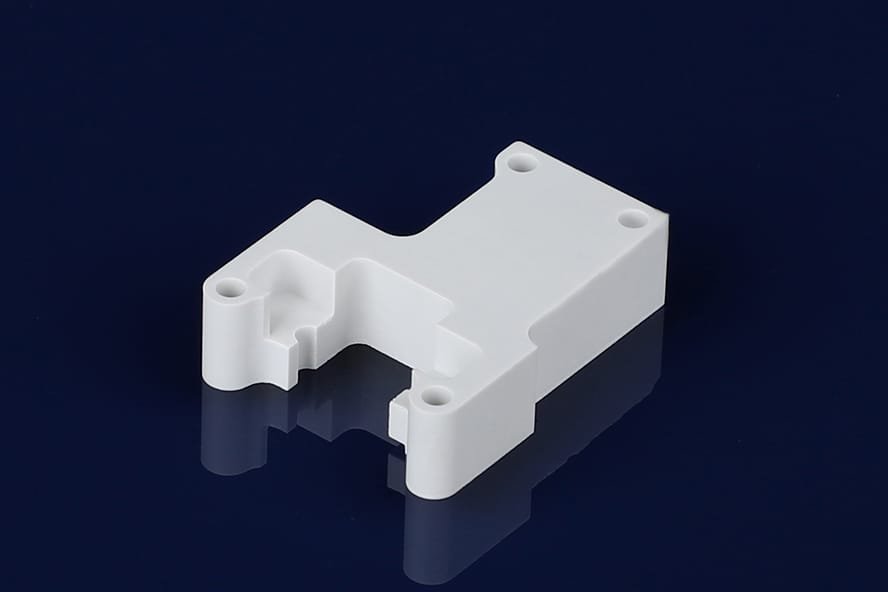
Strict machining with an accuracy of up to 0.001mm can be achieved
Macor machinable glass ceramic developed by Corning is a high-performance polycrystalline composite material that is white throughout. Its most distinctive feature is that it has zero porosity and zero air leakage. It also has the ability to be processed by standard metal tools and is widely used in high-end manufacturing.

Macor Advantages
- Easily machinable with standard metalworking tools.
- Supports extremely tight machining tolerances, up to 0.0005 inches (0.013 mm).
- Completely non-porous and suitable for vacuum applications without risk of outgassing.
- No firing is required after machining, simplifying the manufacturing process.
- High Precision: It allows for high dimensional accuracy and surface finish, making it ideal for applications requiring intricate parts.
- Macor endures continuous use at temperatures up to 1000°C without degrading, ideal for high-temperature applications
- Exhibits low thermal conductivity, making it an effective high-temperature insulator.
- Macor is resistant to most chemicals, including acids, bases, and solvents, making it suitable for harsh chemical environments.
- Strong and rigid, maintaining its shape without creeping or deforming, unlike high-temperature plastics.
- Tailored Designs: Macor can be customized to meet specific industrial requirements, offering flexibility in design and application.
- Material Compatibility: Macor can be easily combined with metals and glass, enhancing its versatility in various applications.
Macor Applications
- Ultra-high vacuum systems, feedthroughs, and insulators.
- Semiconductor equipment fixtures, insulators, and precision parts.
- Mass spectrometers, ion traps, and low-temperature systems.
- Surgical instruments, diagnostics, and imaging components.
- Electric insulators in ion thrusters.
- Electrode holders for plasma generators.
- Structural supports for high-voltage equipment and transformers.
- Precision coil formers (stable and high precision).
- Spacers, cavities, and reflectors in laser assemblies.
- Satellite system supports (thermally and electronically insulating)
Macor Material Properties
Thermal Properties
| Thermal | SI/Metric | Imperial |
| CTE -100°C – 25°C | 81 × 10⁻⁷ /°C | 45 × 10⁻⁷ /°F |
| CTE 25°C – 300°C | 90 × 10⁻⁷ /°C | 50 × 10⁻⁷ /°F |
| CTE 25°C – 600°C | 112 × 10⁻⁷ /°C | 62 × 10⁻⁷ /°F |
| CTE 25°C – 800°C | 123 × 10⁻⁷ /°C | 68 × 10⁻⁷ /°F |
| Specific Heat, 25°C | 0.79 kJ/kg·°C | 0.19 Btu/lb·°F |
| Thermal Conductivity, 25°C | 1.46 W/m·°C | 10.16 Btu·in/hr·ft²·°F |
| Thermal Diffusivity, 25°C | 7.3 × 10⁻⁷ m²/s | 0.028 ft²/hr |
| Continuous Operating Temperature | 800°C | 1472°F |
| Maximum No Load Temperature | 1000°C | 1832°F |
Mechanical Properties
| Mechanical | SI/Metric | Imperial |
| Density | 2.52 g/cm³ | 157 lbs/ft³ |
| Porosity | 0% | 0% |
| Young’s Modulus, 25°C (Modulus of Elasticity) | 66.9 GPa | 9.7 × 10⁶ PSI |
| Poisson’s Ratio | 0.29 | 0.29 |
| Shear Modulus, 25°C | 25.5 GPa | 3.7 × 10⁶ PSI |
| Knoop Hardness, 100g | 250 kg/mm² | — |
| Modulus of Rupture, 25°C (Flexural Strength) | 94 MPa (Minimum specified average value) | 13,600 PSI |
| Compressive Strength (After polishing) | 345 MPa (up to 900 MPa) | 49,900 PSI (130,000 PSI) |
Electrical Properties
| Electrical | SI/Metric | Imperial |
| Dielectric Constant, 25°C | — | — |
| 1 kHz | 6.01 | 6.01 |
| 8.5 GHz | 5.64 | 5.64 |
| Loss Tangent, 25°C | — | — |
| 1 kHz | 0.004 | 0.004 |
| 8.5 GHz | 0.0025 | 0.0025 |
| Dielectric Strength (AC) avg. (25°C, under 0.3 mm thickness) | 45 kV/mm | 1143 V/mil |
| Dielectric Strength (DC) avg. (25°C, under 0.3 mm thickness) | 129 kV/mm | 3277 V/mil |
| DC Volume Resistivity, 25°C | 10¹⁷ Ohm·cm | 10¹⁷ Ohm·cm |
Note: This value is for reference only and may vary slightly depending on the batch conditions.
Machining Macor
Although Macor has the ability to process with standard metal tools, there are still some problems compared with metal (please check our latest machining guide for 2025). Ultra-precision machining can be achieved by using alloy milling cutters and correct machining parameters. For example, micro holes can be processed to 0.05mm, and internal threads can reach M1.4, but M1.4 needs to consider its practicality (it is recommended to be larger than M2). In addition, when processing threads, attention should be paid to edge collapse, which is recommended to be solved by chamfering. In terms of cooling, it is recommended to choose water-soluble coolant, which is not easy to adhere to the tool.
Jundro Ceramics is a professional precision manufacturer of Macor Machinable Ceramic materials. We specialize in utilizing our technical expertise and advanced equipment to process high-precision products. Our comprehensive service scope includes material selection, precision machining, surface treatment, and quality testing to ensure that each product can perform at its best in practical applications. If you would like to purchase Macor boards, rods, bars, tubes, or custom machined parts, please contact us
Macor Prototype Machining
Our video showcases the process of prototype machining for Machinable Glass Ceramic
Related Materials and Consultation

Frequently Asked Questions
Macor is a machinable glass-ceramic developed by Corning Incorporated. It is composed of fluorophlogopite and borosilicate glass, and is a white, zero-porosity, zero-outgas material with excellent insulation properties that can be processed without sintering.
Macor ≈ Top-tier / Mid-to-high end of the high-insulation ceramic category
It possesses high dielectric strength and extremely high volume resistivity, maintaining insulation even under continuous high-temperature environments.
While Macor may not be the best insulating ceramic, its ease of processing and high UHV compatibility make it a highly practical high-insulation material for real-world applications.
There are many methods for machining macros, and standard metalworking and ceramic machining methods can be used: milling, turning, drilling, sawing, grinding, tapping, reaming, and polishing (for more details, please click here to learn about our 2025 Machining Macro Guide).
Both Macor and Shapal are machinable ceramics, but the difference lies in their properties. Shapal (Hi-M) is an AlN-based machinable material, prioritizing heat dissipation and higher structural strength, while Macor prioritizes vacuum performance and electrical insulation. In terms of price, Shapal is significantly more expensive, while Macor offers a much more cost-effective solution for complex machining and small-batch production.
SSiC (Sintered SiC): Highest strength, purity, hardness, and corrosion resistance. Best for mechanical seals, semiconductor parts, and high-wear components.
RBSiC (Reaction-Bonded SiC): Lower cost, easier to form complex shapes, but slightly lower strength and some residual Si. Good for structural parts and large components.
CVD SiC: Ultra-pure, extremely dense, mirror-polish capable, ideal for semiconductor, optical, and vacuum applications. Highest performance and cost.
How to choose:
Wear & sealing: SSiC
Complex shapes & lower cost: RBSiC
Optical/semiconductor: CVD SiC
High-temperature structural: SSiC
Yes — we support small-batch and prototype machining of Macor®. Contact us with your drawing (STEP/2D) and tolerance requirements and we’ll provide a quote and lead time. (If you need sample parts or a material certificate, we can supply those.)
 English
  简体中文
简体中文  Español
  Deutsch (Sie)
  日本語
日本語 


