
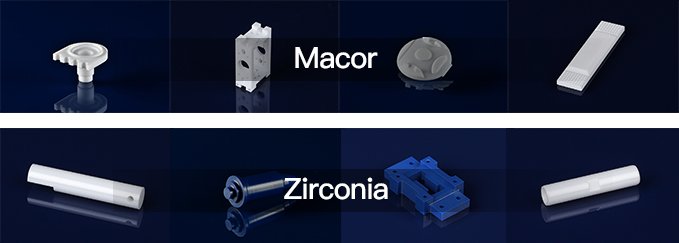
When selecting advanced ceramic materials for precision equipment components, two materials often stand out. Macor machinable glass-ceramic and Zirconium oxide (ZrO₂). Both materials have their uses in industries such as engineering, semiconductors, and medicine. This article compares the key properties, advantages, and typical applications of these two materials to help you select the right ceramic for your equipment components.
Material Composition and Structure
Macor is a glass-ceramic composite consisting of a silicate glass matrix reinforced with fluorophlogopite mica crystals. This unique structure gives it a balance of machinability and thermal stability, allowing it to be shaped using standard metalworking tools.
Zirconia is a fully crystalline ceramic stabilized with yttria or magnesia. It is known for its exceptional strength, fracture toughness, and wear resistance, making it one of the toughest ceramics available.
Machinability and Fabrication
Macor is easily machined using conventional CNC tools—turning, drilling, and milling can be performed without diamond tooling. This makes it ideal for rapid prototyping, low-volume production, and complex custom parts.
Zirconia, on the other hand, requires diamond grinding or laser machining due to its hardness and toughness. While machining cost is higher, it offers superior long-term performance under load and abrasion.
👉 If fast turnaround and design flexibility are priorities, Macor is the better choice. If extreme durability is required, Zirconia is preferred.
Mechanical and Thermal Properties
| Property | Macor | Zirconia (Y-TZP) |
| Density (g/cm³) | 2.52 | 6 |
| Flexural Strength (MPa) | 94 | 900+ |
| Thermal Expansion (×10⁻⁶/K) | 9.3 | 10.5 |
| Max Working Temperature (°C) | 800 (continuous), 1000 (peak) | 1000 (continuous) |
| Thermal Conductivity (W/m·K) | 1.46 | 2.5 |
| Electrical Resistivity (Ω·cm) | 10¹⁴ | 10¹⁰–10¹² |
| Machinability | Excellent | Poor |
Summary:
Macor offers excellent machinability and electrical insulation, while Zirconia provides much higher strength and wear resistance.
Chemical and Environmental Resistance
Macor: Chemically stable in most environments but may be attacked by strong acids or bases at elevated temperatures.
Zirconia: Excellent corrosion resistance, even in harsh or reactive chemical environments.
For vacuum, optical, or electrical insulation applications, Macor is ideal. For contact with liquids, abrasives, or corrosive chemicals, Zirconia performs better.
Applications
Macor Applications:
UHV and vacuum system insulators
Semiconductor fixtures
Aerospace optical mounts
Precision alignment components
Research and prototyping parts
Zirconia Applications:
Pump valves and plungers
Bearings and bushings
Medical implants
High-wear mechanical seals
Industrial cutting or grinding components
Conclusion
Both Macor and Zirconia are exceptional materials in precision ceramic engineering — they simply serve different design goals.
If your application demands tight tolerances, electrical insulation, and complex geometry, Macor machining services offer unmatched flexibility.
If you need high mechanical strength, wear resistance, or long service life, Zirconia components are the optimal choice.
 English
  简体中文
简体中文  Español
  Deutsch (Sie)
  日本語
日本語