
In ceramic machining, one of the most common questions we discuss with customers is:
“Can this corner be made as a sharp 90-degree angle?”
In most cases, the answer is no.
Unlike metals, ceramics cannot reliably maintain sharp corners. Instead, corners should be designed with chamfers (C) or fillets (R). Understanding why this is necessary—and how to choose between C and R—is critical for successful ceramic part design and manufacturing.

Why Sharp Corners Are Not Recommended in Ceramic Parts
Ceramic materials are characterized by high hardness and high brittleness. While these properties make ceramics excellent for wear resistance, thermal stability, and electrical insulation, they also introduce a key limitation:
Sharp corners create stress concentration.
At a 90-degree corner, mechanical stress, thermal stress, and residual machining stress tend to accumulate. In ceramics, this often leads to:
Edge chipping
Micro-crack initiation
Fracture during machining, assembly, or service
In addition, ceramic cutting tools cannot achieve the same sharpness as metal tools. Tool geometry, tool radius, and brittleness of the material all make true sharp corners impractical.
For these reasons, sharp internal or external corners should be avoided at the design stage.
Chamfer (C) vs Fillet (R): What’s the Difference?
Chamfer (C) is a straight, angled cut applied to a corner.
Commonly a 45° chamfer
Designated as C0.5, C1.0, etc.
Example:
C0.5 means 0.5 mm is removed along both adjacent edges
Chamfers are simple, economical, and widely used—especially on external edges.
Fillet (R) (or radius) is a rounded corner formed by a circular arc.
Designated as R0.5, R1, R2, etc.
The value represents the radius of the arc
Example:
R1 means a 1 mm radius fillet
Fillets are highly effective at reducing stress concentration and are essential in internal corners.
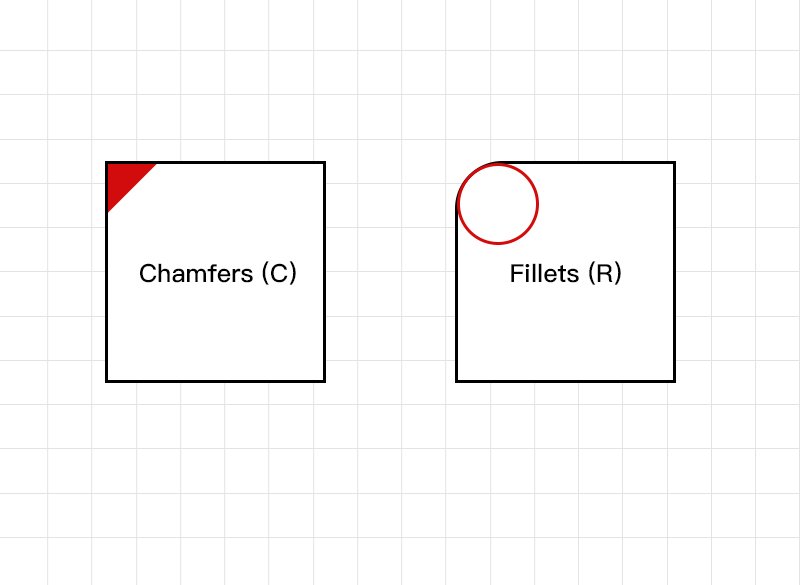
The Most Practical Design Rule
External corners are chamfered (C-corners), while internal corners are rounded (R-corners).
For external edges, chamfering is easier, more efficient, and less costly to machine.
However, for internal corners, rounded corners are essential, and C-corners are practically impossible to produce on internal corners (due to tool interference).
Conclusion
Choosing between C and R is not just a drawing detail—it directly affects whether a ceramic part can be machined reliably.
In summary:
- Ceramics cannot handle sharp corners like metals
- Chamfers (C) are ideal for external edges
- Fillets (R) are essential for internal corners
- Proper corner design improves strength, yield, and cost efficiency
If you are unsure which edge treatment method is suitable for your ceramic parts, we recommend consulting us in the early design stages. Jundro Ceramics is a manufacturer with many years of experience in advanced ceramic machining and can help you avoid costly modifications later.
 English
  简体中文
简体中文  Español
  Deutsch (Sie)
  日本語
日本語