
Alumina ceramic etching rings are consumable but critical components in plasma etching systems. They control plasma distribution, shield chamber hardware, and reduce contamination near the wafer edge. One of our clients, an ICP plasma etching equipment manufacturer, contacted us due to edge erosion and particle alarm issues. Our solution was to upgrade the alumina purity from 99% to 99.8% and optimize the surface finish of the plasma area, helping to extend the client’s service life.
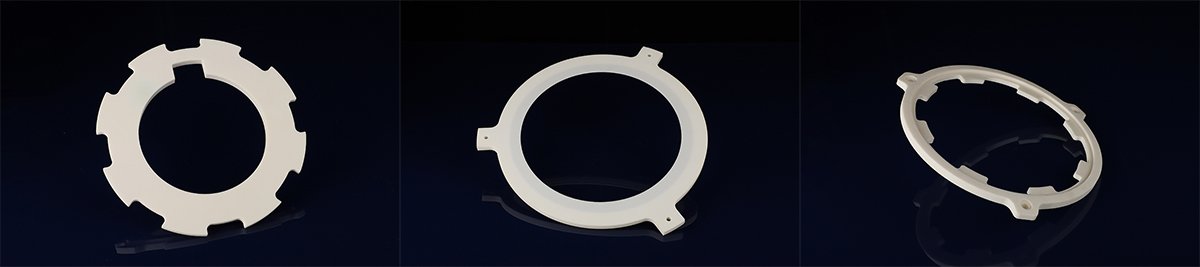
Why High-Purity Alumina Is Used Plasma & Chemical Resistance
Plasma & Chemical Resistance
High-purity Al₂O₃ (99.7–99.99%) resists fluorine-based plasma attack
Stable surface chemistry limits uncontrolled erosion
Slower wear rate compared with low-purity alumina
Particle Control
- Dense microstructure reduces grain pull-out
- Polished functional surfaces minimize particle shedding
- Critical for advanced nodes where edge defects matter
Thermal Stability
Maintains geometry during repeated heating and cooling
Prevents edge distortion that affects plasma uniformity
Typical Technical Specifications
Final values depend on chamber design and process conditions. Below are realistic engineering ranges, not marketing numbers.
- Material purity: 99.5% / 99.7% / 99.8% Al₂O₃
- Density: ≥ 3.93 g/cm³
- Dimensional tolerance: ±0.001 mm on critical surfaces
- Flatness: ≤ 0.001 mm
- Surface finish: Ra ≤ 0.01 µm (plasma-facing areas)
- Dielectric strength: suitable for RF plasma environments
- Vacuum compatibility: UHV compatible after proper bake-out
Where Alumina Etching Rings Are Used
ICP / RIE plasma etching chambers
Dielectric and metal etch processes
Logic and memory wafer fabrication
Tool platforms requiring consumable ceramic shielding
 English
  简体中文
简体中文  Español
  Deutsch (Sie)
  日本語
日本語